 Watch on YouTube (Optional)
ISO 22000 establishes requirements for a Food Safety Management System to help organizations in the food chain identify and control food safety hazards, ensuring food is safe for consumption. It applies to all types and sizes of food-related businesses and combines communication, prerequisite programs, and HACCP principles within a management system aligned with ISO’s structure. The standard uses the PDCA approach to support continual improvement and consistent hazard control. The key points as described in standard are given below.
-
General
The benefits of adopting this standard to organisations are
- Ability to provide consistent food products and services
- Addressing risk associated with objectives.
- the ability to demonstrate conformity to specified FSMS requirements.
- addressing risks associated with its objectives; This standard employs the process approach which incorporates the Plan-Do-Check-Act (PDCA) cycle . and risk-based thinking . The PDCA cycle enables an organization to ensure that its processes are adequately resourced and managed, and that opportunities for improvement are determined and acted on. Risk-based thinking enables an organization to determine the factors that could cause its processes and its FSMS to deviate from the planned results, and to put in place controls to prevent or minimize
-
FSMS principles
Food safety is related to the presence of food safety hazards at the time of consumption (intake by the consumer). Food safety hazards can occur at any stage of the food chain. Therefore, adequate control throughout the food chain is essential. Food safety is ensured through the combined efforts of all the parties in the food chain. This standard specifies the requirements for a FSMS that combines the following generally recognized key elements:
- interactive communication;
- system management;
- prerequisite programmes;
- hazard analysis and critical control point (HACCP) principles.
-
Process Approach
This standard adopts a process approach when developing and implementing a FSMS and improving its effectiveness to enhance production of safe products and services while meeting applicable requirements. The process approach involves the systematic definition and management of processes, and their interactions, so as to achieve the intended results in accordance with the food safety policy and strategic direction of the organization. Management of the processes and the system as a whole can be achieved using the PDCA cycle, with an overall focus on risk-based thinking . The recognition of the organization’s role and position within the food chain is essential to ensure effective interactive communication throughout the food chain. Plan-Do-Check-Act cycle The PDCA cycle can be described briefly as follows:
- Plan: establish the objectives of the system and its processes, provide the resources needed to deliver the results, and identify and address risks and opportunities;
- Do: implement what was planned;
- Check: monitor and (where relevant) measure processes and the resulting products and services,analyse and evaluate information and data from monitoring, measuring and verification activities, and report the results;
- Act:take actions to improve performance, as necessary.
In this standard PDCA cycle works at two levels.
Overall pdca cycle and PDCA cycle specific to clause 8 .
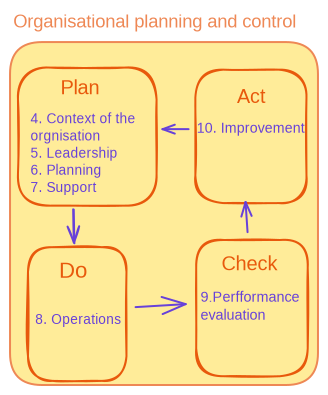
Overall PDCA
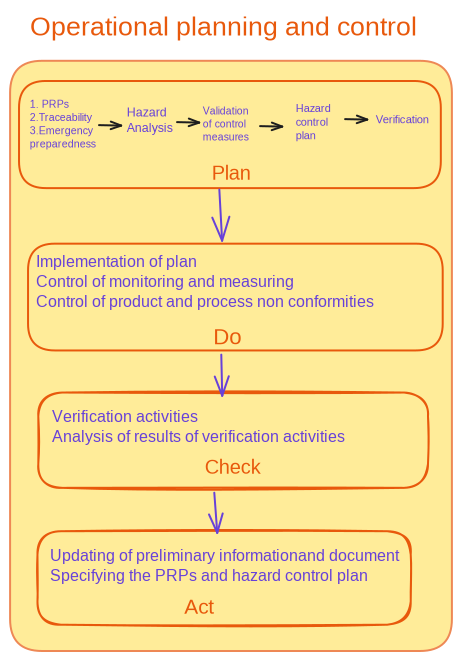
Operations PDCA Risk-based thinking
Risk-based thinking is essential for achieving an effective FSMS. In this document, risk-based thinking is addressed on two levels,
organizational and operational.
Organizational risk management:
Risk is the effect of uncertainty, and any such uncertainty can have positive or negative effects.
In the context of organizational risk management, a positive deviation arising from a risk can provide an opportunity, but not all positive effects of risk result in opportunities.
To conform to the requirements of this document, an organization plans and implements actions to address organizational risks.
Addressing risks establishes a basis for increasing the
effectiveness of the FSMS, achieving improved results and preventing negative effects.
Hazard analysis — Operational processes
The concept of risk-based thinking based on the HACCP principles at the operational level is implicit in this document.
The subsequent steps in HACCP can be considered as the necessary measures to prevent hazards or reduce hazards to acceptable levels to ensure food is safe at the time of consumption.
-
Relationship with other standards
This standard enables an organization to use the process approach, coupled with the PDCA cycle and risk-based thinking, to align or integrate its FSMS approach with the requirements of other management systems and supporting standards. his document is the core principle and framework for FSMSs and sets out the specific FSMS requirements for organizations throughout the food chain. Other guidance related to food safety, specifications and/or requirements specific to food sectors can be used together with this framework.